Most players spend more time customizing their pilot character than reading the actual flight manual - and that habit costs them dearly the first time they attempt a crosswind landing or a tight orbital insertion. The gap between looking good in the cockpit and actually flying well is where most beginners get stuck, and it rarely closes on its own. Choosing the right character build, understanding how physics engines model lift and thrust, and knowing which control scheme fits your hardware are decisions that shape every session that follows.
This guide breaks down the practical side of picking a pilot, tuning your approach to controls, and progressing through the learning curve that separates casual players from confident virtual aviators. Along the way, we'll look at how a well-designed pilot game rewards patience over reflexes, and why the genre has quietly become one of the most technically demanding categories in gaming. If you've bounced off a flight sim before because the manual felt impenetrable, this is the version of that manual written for someone who wants results, not jargon. For players curious about how these mechanics translate into a more casual, arcade-style experience, the pilot game found at https://tez888.in.net/promo/slots/pilot-game/ offers a lighter entry point worth exploring before committing to a full simulator. Everything from character selection to throttle management gets covered, with an eye toward decisions that actually matter once you're airborne.
Understanding What Makes a Great Pilot Game
Not every title that puts you in a cockpit deserves the label. A genuine pilot game distinguishes itself through the depth of its flight model, the responsiveness of its controls, and the consequences it attaches to pilot error. Arcade titles forgive stalls and hard landings; simulators do not, and that distinction matters enormously when you're deciding where to invest your time.
Core Mechanics That Define the Genre
Every credible pilot game builds around three pillars: aerodynamics (or orbital mechanics, in space-based titles), instrumentation, and player feedback. The aerodynamics model determines how your aircraft responds to speed, angle of attack, and control surface input. Instrumentation gives you the data to make decisions - altitude, heading, fuel state, structural stress. Feedback, whether visual, audio, or haptic, tells you when you're pushing past safe limits before the aircraft tells you the hard way.
Arcade vs Simulation Approaches
Arcade-style pilot games prioritize immediate fun. Controls are simplified, damage models are forgiving, and mission structures reward speed over precision. Simulation-focused titles do the opposite: they model fuel burn, weather interaction, and mechanical failure with exacting detail. Neither approach is objectively superior - the right choice depends on whether you want a relaxing session or a genuine skill-building exercise.
Why Realism Levels Vary So Widely
Development studios calibrate realism based on their target audience. A title aimed at newcomers will strip away complexity to avoid overwhelming first-time players, while a hardcore simulator assumes you already understand terms like trim, yaw damper, and glide ratio. Knowing your own tolerance for complexity before you buy or download anything will save you frustration later.
- Arcade titles: fast onboarding, forgiving physics, short mission loops
- Mid-tier simulators: realistic flight models with simplified systems management
- Hardcore simulators: full systems depth, procedural checklists, punishing failure states
How to Choose the Best Pilot Character for Your Playstyle
Your pilot character isn't just a cosmetic layer. In many titles, character choice affects stat allocation, starting equipment, or even narrative branches that open different mission types later in the campaign.
Matching Character Stats to Your Preferred Missions
If a game offers attribute points - reaction time, stress tolerance, technical aptitude - align them with the missions you enjoy most. Combat-focused pilots benefit from reflex and situational awareness stats, while long-haul cargo or exploration pilots gain more from endurance and technical repair skills. Spreading points evenly usually produces a mediocre character who struggles at everything rather than excelling at anything.
Backstory and Progression Paths
Many pilot games attach a backstory to character creation that unlocks specific dialogue options, faction reputations, or bonus starting gear. A military-trained background might grant faster access to fighter craft, while a civilian courier origin could open smuggling routes or trade contracts earlier. Read these options carefully - they often lock you into a progression lane that's expensive or slow to change mid-campaign.
Customization Options That Actually Affect Gameplay
Cosmetic customization - helmet design, cockpit livery, voice lines - has no mechanical impact, but some games disguise functional choices as aesthetic ones. A particular flight suit might carry a hidden stat bonus, or a chosen call sign might affect how NPC squadrons treat your character. Always check patch notes or community wikis before assuming a customization option is purely visual.
Mastering Pilot Gameplay: Controls, Physics, and Strategy
Once your character is set, the real work begins. Pilot gameplay rewards muscle memory and situational reading far more than quick reflexes alone.
Setting Up Your Control Scheme
Keyboard-and-mouse setups work for arcade titles but fall short in simulators that demand fine analog input for throttle, rudder, and pitch. A dedicated joystick with throttle quadrant dramatically improves precision in both aviation and space-based titles. Spend time in the calibration menu before your first flight - mismatched dead zones are the single most common cause of unexplained crashes among new players.
Reading the HUD and Instrument Panel
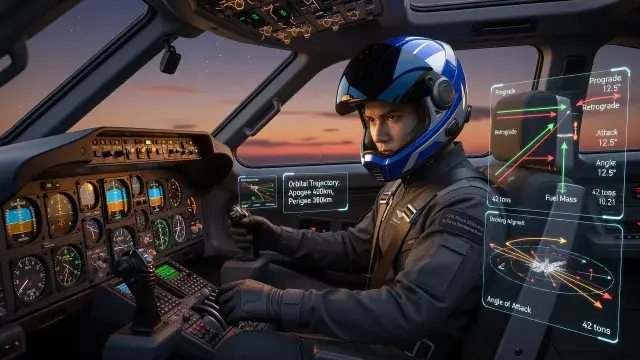
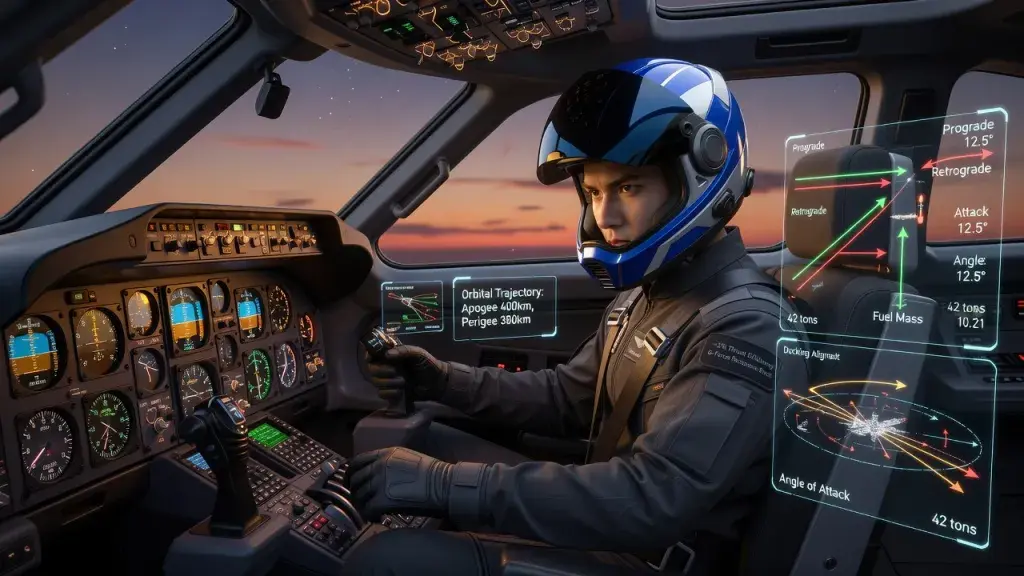
Every instrument exists to answer a specific question: how fast am I going, how much fuel remains, am I level with the horizon. Learn to scan these in a consistent pattern rather than fixating on one gauge. Pilots who ignore the artificial horizon in favor of watching the outside view are the ones who end up in unrecoverable spins.
Managing Stall, Thrust, and Momentum
Stalls happen when angle of attack exceeds what the wing can sustain - not simply from flying slowly. Understanding this distinction changes how you recover: pushing the nose down to regain airflow works, while pulling back only worsens the stall. In spaceflight contexts, momentum management replaces aerodynamic stall recovery entirely, since there's no air to generate lift or drag.
Building Muscle Memory Through Repetition
Repeated practice on a single maneuver - a stabilized approach, an orbital rendezvous burn - builds the kind of automatic response that frees mental bandwidth for decision-making during complex missions. Pilots who skip repetition and jump straight into advanced scenarios tend to plateau early and blame the game rather than their own preparation.
Spaceflight Simulator Essentials: From Orbit to Docking
Spaceflight simulator titles remove atmosphere from the equation entirely, replacing lift and drag with orbital mechanics governed by gravity and momentum alone.
Understanding Orbital Mechanics Basics
Speeding up doesn't always mean going faster in the direction you want - in orbit, thrust applied prograde raises your orbit on the opposite side, while retrograde thrust lowers it. This counterintuitive relationship confuses players coming from aviation backgrounds, where throttle and speed correlate directly.
Docking Procedures and Precision Maneuvering
Docking sequences demand fine control over relative velocity, not raw speed. Successful pilots close the distance slowly, matching rotation and closing rate simultaneously rather than rushing the final approach. Most spaceflight simulator failures during docking come from overcorrecting small errors rather than from the initial approach itself.
Resource Management in Zero Gravity
Fuel, oxygen, and power reserves function as hard constraints in most space titles. Unlike aircraft, where you can glide to a runway on empty tanks, a spacecraft stranded without propellant has no fallback option. Planning burns conservatively and keeping a reserve margin separates pilots who complete missions from those who drift indefinitely.
Aviation Flight Simulator Fundamentals for Realistic Flying
Aviation-focused titles trade orbital complexity for atmospheric nuance - wind shear, density altitude, and runway conditions all shape how an aircraft behaves.
Takeoff, Cruise, and Landing Phases
Each phase demands a different mental checklist. Takeoff focuses on rotation speed and initial climb rate; cruise shifts attention to fuel efficiency and navigation; landing narrows everything down to airspeed control and glide path management. Treating these as distinct phases, rather than one continuous task, improves consistency dramatically.
Weather Systems and Their Impact on Flight
Crosswinds, turbulence, and low visibility change how an aircraft handles far more than most beginners expect. A well-modeled aviation flight simulator will punish a pilot who ignores crosswind correction on final approach just as harshly as real-world conditions would. Learning to read weather cues before takeoff prevents avoidable mid-flight surprises.
Aircraft Types and Their Handling Differences
A light single-engine trainer handles nothing like a heavy twin-jet transport. Control response, stall speed, and momentum all scale with aircraft weight and design. Pilots who master one aircraft category shouldn't assume that skill transfers directly - each airframe has its own quirks worth learning individually.
Choosing the Right Game for Your Skill Level and Goals
The pilot game market spans casual mobile titles to full-fidelity simulators requiring specialized hardware. Matching your choice to your actual goals - relaxation, skill-building, or competitive play - prevents wasted money and frustration.
Casual and Arcade-Style Options
These titles suit players who want quick sessions without a steep learning curve. Controls are intuitive, mission lengths are short, and failure states rarely end a session entirely.
Mid-Level Simulators for Growing Skill
Mid-tier titles introduce real systems management - fuel planning, basic navigation, weather effects - without demanding the full procedural depth of professional-grade software. These are ideal for players ready to move past pure arcade mechanics.
Hardcore Simulators for Serious Enthusiasts
Full-fidelity simulators model cockpit switches, checklists, and failure modes in exhaustive detail. These titles suit players willing to invest real time in learning procedures that mirror actual aviation or spaceflight training.
- Casual play: short sessions, forgiving mechanics, minimal setup
- Growth-focused play: moderate depth, meaningful systems, manageable learning curve
- Enthusiast play: full procedural realism, dedicated hardware, long-term mastery
Frequently Asked Questions
Do I need a joystick to enjoy a pilot game seriously?
A joystick isn't mandatory for casual or arcade titles, but it becomes almost essential once you move into mid-tier or hardcore simulators. Analog throttle and stick input allow far more precise control than a keyboard can offer, particularly during landing and docking sequences.
What's the biggest difference between flying in an aviation simulator and a spaceflight simulator?
Aviation simulators rely on aerodynamic forces - lift, drag, and stall behavior tied to airspeed and angle of attack. Spaceflight simulators replace these with orbital mechanics, where thrust direction relative to your orbit matters more than raw speed.
How much does pilot character choice actually affect gameplay?
In games with RPG-style progression, character choice can meaningfully shape which missions, equipment, and factions you access early on. In more mechanically focused simulators, character selection is often cosmetic and has little bearing on actual flight performance.
Is it better to start with an arcade title before moving to a full simulator?
Starting casual helps build basic spatial awareness and control familiarity without the frustration of a steep learning curve. Once comfortable, transitioning to a deeper simulator becomes far less intimidating because core instincts already exist.
Why do I keep stalling my aircraft even at what feels like a safe speed?
Stalls are caused by excessive angle of attack, not low speed alone - you can stall at high speed during a steep climb or tight turn. Focus on managing pitch input relative to your flight path rather than watching the speed indicator exclusively.
What should I prioritize first when learning docking maneuvers in space titles?
Prioritize matching relative velocity before worrying about closing distance quickly. Small, controlled thrust inputs early in the approach prevent the overcorrections that cause most failed docking attempts.