A blue verification badge on Facebook carries real weight. It signals authenticity, filters out impersonators, and immediately communicates credibility to anyone who lands on a profile or page. For brands, public figures, and businesses competing for attention on social media, that small checkmark can be the difference between being trusted on sight and being scrolled past entirely.
The demand for verified accounts has grown steadily as Facebook's own verification process has become more selective and, at times, opaque. This has led many individuals and organizations to explore secondary markets where established, verified accounts are available for acquisition. For those who want to buy facebook account verified through a structured marketplace, platforms like accsmarket.com offer catalogued options with account details available before purchase - a practical starting point for anyone researching this route seriously.
This guide is written for people who have already decided to explore the purchase of a verified Facebook account and want to do it without losing money, getting scammed, or ending up with an account that collapses within days of acquisition. It covers what verification actually means on Facebook, how the secondary market works, what due diligence looks like in practice, and how to manage a purchased account responsibly over time. Whether you are looking to acquire Facebook verified page assets for a brand or seeking a verified Facebook profile for sale that fits a personal or professional use case, the following sections will give you a clear, practical framework.
Understanding Facebook Verification and Why It Matters
What the Verification Badge Actually Represents
Facebook's verification badge - the blue checkmark displayed next to a name - is issued by Meta to confirm that an account belongs to the authentic person, brand, or organization it claims to represent. It is not simply a reward for popularity. Verification is tied to identity confirmation and, in many cases, to the public interest associated with the account holder.
The badge serves a specific function: it tells visitors that the account has been reviewed and confirmed as genuine. This matters most in contexts where impersonation is common - celebrity profiles, major brands, news organizations, and influential public figures. On a practical level, verified accounts tend to attract more follows, more engagement, and more trust from first-time visitors simply because the checkmark removes doubt about legitimacy.
For businesses and professionals, operating from a verified Facebook account with verified badge status also affects how partners, collaborators, and customers perceive the brand before any direct interaction takes place.
The Difference Between a Verified Profile and a Verified Page
Facebook distinguishes between personal profiles and pages, and verification applies differently to each. A verified personal profile typically belongs to a public figure - a journalist, politician, athlete, or entertainer - whose identity needs to be confirmed for the public record. A verified page, by contrast, represents a business, organization, media outlet, or public brand.
When you look at the secondary market, this distinction matters considerably. A verified profile carries personal identity history and may be more difficult to rebrand without triggering a review. A verified page, particularly one built around a topic or brand rather than a specific individual, is generally more transferable and adaptable to new ownership.
Understanding which type of asset you actually need before entering any marketplace will save both time and money. Buyers who conflate the two often end up with an account that technically has a badge but functionally does not suit their intended use.
How Meta's Verification Process Works Officially
Meta offers two official pathways to verification. The first is an organic review process where notable public figures or organizations can apply through account settings, submitting documentation to prove identity and public presence. Approval is selective and can take weeks, with no guaranteed outcome. Many applicants are rejected without detailed explanation.
The second pathway is Meta Verified, a paid subscription service rolled out in recent years that provides a verification badge along with additional account support features. However, Meta Verified has specific eligibility requirements, is primarily aimed at individual creators, and does not automatically replicate the credibility associated with badges earned through the traditional review process.
These official processes being limited or slow is one of the main reasons a secondary market for verified accounts exists. For entities that need credibility immediately - a newly launched brand, an event promoter, or a business entering a competitive space - waiting months for a review that may never succeed is not a viable strategy.
The Secondary Market for Verified Facebook Accounts
How This Market Operates
The secondary market for verified social media accounts functions similarly to other digital asset markets. Sellers list accounts with detailed descriptions of their history, audience size, engagement metrics, niche relevance, and verification status. Buyers review these listings, ask questions, negotiate pricing, and complete transactions through escrow systems or platform-mediated transfers.
Reputable marketplaces in this space maintain catalogues organized by platform, account type, and follower count. When you purchase FB profile verified through a structured platform, you are typically receiving access credentials along with a documented transfer process. The best platforms also provide some form of after-sale support for a defined period, covering issues like login complications or unexpected platform flags.
The market is real, active, and used by a wide range of buyers - from individual entrepreneurs to marketing agencies managing client social media portfolios. What varies widely is the quality and reliability of individual sellers and platforms, which is why the due diligence process described later in this article is non-negotiable.
Types of Verified Accounts Typically Available
Not all listings in this market are equal. Understanding what is genuinely available helps set realistic expectations before you commit to any purchase.
- Verified pages with established follower bases in specific niches (entertainment, news, lifestyle, business)
- Verified profiles previously associated with public figures who have since become inactive
- Verified business pages that have rebranded successfully and retain their badge status
- Aged accounts with verification that have maintained consistent activity over multiple years
- Accounts with both verification and a clean violation history - the most desirable and typically most expensive category
The age of an account often correlates with its stability. An older verified account tends to have a more established behavioral pattern on the platform, which makes it less likely to trigger automated reviews following a change in ownership or usage patterns.
Pricing Factors in the Verified Account Market
Prices for a Facebook account with verified badge vary significantly depending on several variables. There is no universal rate card, but understanding what drives pricing allows buyers to evaluate whether a listing represents fair value.
| Factor | Impact on Price |
|---|---|
| Account age | Older accounts command higher prices due to platform stability |
| Follower count | Larger audiences increase value, especially if engagement is genuine |
| Niche relevance | Accounts in high-demand niches (business, entertainment) are priced higher |
| Violation history | Clean accounts with no strikes or restrictions are significantly more valuable |
| Type of verification | Traditionally earned badges often carry more value than subscription-based ones |
| Geographic audience | Accounts with audiences in high-value markets typically cost more |
Buyers should be cautious of listings priced dramatically below market averages. An unusually low price for a verified account is almost always a signal of problems - whether a fabricated follower base, an account under review, or an outright scam.
Due Diligence Before Making Any Purchase
Verifying the Account's Actual Status
Before committing to any acquisition, verify the badge status independently. Do not rely solely on screenshots provided by the seller - these are trivially easy to fabricate. Instead, request the exact URL of the account, search for it directly on Facebook, and confirm with your own eyes that the badge is present and the account is active.
While you are there, look beyond the badge. Check when the account was created, how frequently it posts, whether the engagement on posts looks organic, and whether the follower count is consistent with the level of interaction visible on content. An account showing 200,000 followers but generating minimal reactions on posts is a red flag, regardless of whether it carries a verification badge.
Checking Account History and Violation Records
A verified account's history matters as much as its current status. Ask the seller directly about any past restrictions, temporary bans, content removals, or appeals to Meta. A responsible seller on a reputable platform will provide this information without resistance. Evasiveness on these questions is a reliable indicator of problems.
If you are acquiring a page rather than a profile, look at the Page Transparency section visible publicly on Facebook. This section shows when the page was created, whether its name has changed, and in some cases where the administrators are located. Frequent name changes or a creation date that contradicts the seller's claims about the account's history should give you pause.
Evaluating the Seller and Platform
The platform through which you acquire a verified Facebook page matters as much as the account itself. Established marketplaces with verified seller ratings, dispute resolution systems, and transaction escrow reduce the risk of fraud significantly compared to informal arrangements made through social media or messaging apps.
- Check for a documented track record: how long has the platform been operating?
- Look for buyer reviews specific to the seller you are considering
- Confirm that the platform uses escrow or a comparable buyer protection mechanism
- Review the platform's refund and dispute policies before completing payment
- Avoid platforms that require full upfront payment with no recourse if the account is not as described
Private sellers operating outside established marketplaces carry a substantially higher risk profile. If the deal happens entirely via direct messages and the seller pressures you to pay quickly, treat that as a serious warning sign.
Understanding What Transfers with the Account
When you buy verified social media account assets, what actually transfers is more complex than simply receiving a password. Clarify the following before finalizing any agreement:
- Will the recovery email and phone number be transferred to your control?
- Are there any linked ad accounts, and will they be included or removed?
- Is the account connected to any third-party applications that will require disconnection?
- What is the process for changing the account's associated identity information post-transfer?
Incomplete transfers - where you receive login credentials but the original owner retains recovery access - are one of the most common methods by which buyers lose accounts shortly after purchase. Insist on full access transfer before releasing any payment through the escrow system.
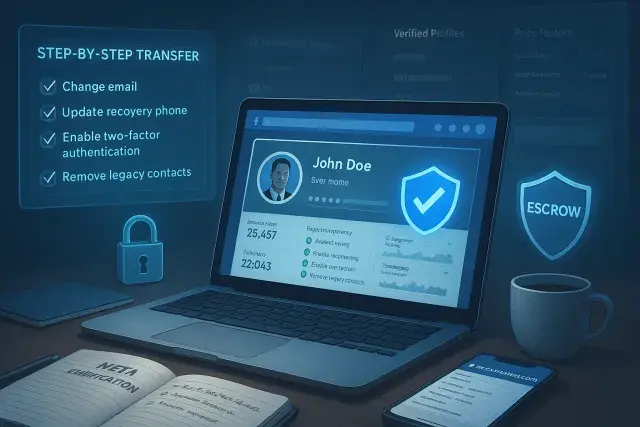
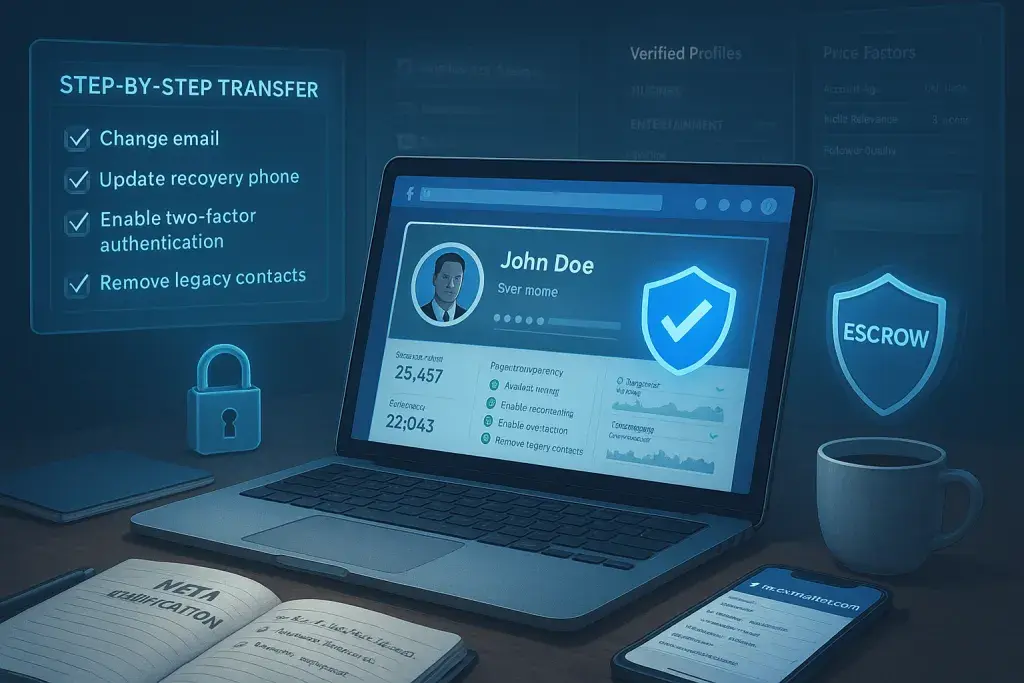
The Transfer Process: Step by Step
A safe transfer of a verified Facebook account follows a specific sequence. Deviating from this sequence, particularly under pressure from the seller, introduces risk at every stage.
- Agree on all terms in writing through the platform's messaging system, creating a documented record.
- Initiate payment through the platform's escrow service - funds are held until the transfer is confirmed complete.
- Receive the initial login credentials and verify access to the account before proceeding further.
- Change the primary email address associated with the account to one you own and control exclusively.
- Change the password immediately after gaining access.
- Update the recovery phone number to your own number.
- Remove any trusted contacts or legacy contacts set by the previous owner.
- Disconnect any third-party applications linked to the account.
- Confirm all access points are under your control, then release escrow payment.
- Enable two-factor authentication using your own authenticator app or phone number.
Do not release escrow funds before completing steps four through nine. Once payment is released, you lose the primary form of leverage available to you if problems surface.
Risks, Legal Considerations, and Platform Policies
What Facebook's Terms of Service Say
Facebook's terms of service prohibit the transfer or sale of accounts. This is a factual aspect of using the platform that anyone considering a purchase must understand clearly. The platform's rules state that accounts are non-transferable and that selling access to accounts violates community standards.
This does not mean verified Facebook profiles for sale do not exist or that transactions do not happen - clearly they do, at scale, across multiple markets. But it does mean that buyers accept a degree of platform risk when acquiring any account through a secondary market. An account that Meta determines has changed hands in violation of its policies may be subject to review, restriction, or removal.
Practical Risk Management After Purchase
The most effective way to protect a purchased account is to operate it as naturally and consistently as possible after acquisition. Sudden, dramatic changes in behavior - posting frequency, content type, audience targeting, location of access - are more likely to attract automated review than gradual, organic transitions.
- Use a consistent IP address and device when first logging in, ideally matching the geographic region associated with the account's history
- Avoid bulk actions like mass unfollowing, rapid posting, or aggressive sharing in the days immediately after transfer
- Introduce brand or identity changes incrementally rather than all at once
- Keep the account active with regular, quality content to signal normal usage patterns
- Monitor notification emails from Meta and respond promptly to any identity verification requests
Buyers who treat a newly acquired account with the same care they would apply to a newly opened account tend to experience significantly fewer platform complications in the weeks following purchase.
Financial and Fraud Risks to Anticipate
The financial risks in this market are concentrated around a few recurring patterns. Being aware of them in advance allows you to structure your transaction to avoid them.
| Risk Type | Description | How to Mitigate |
|---|---|---|
| Fake listings | Accounts that appear verified but the badge has been faked through image manipulation | Always verify the account URL independently before paying |
| Partial transfer fraud | Seller retains recovery access and reclaims the account after payment | Complete full access transfer before releasing escrow |
| Already-flagged accounts | Account is under a pending restriction or review at the time of sale | Request violation history documentation and check Page Transparency |
| Inflated metrics | Follower counts boosted by inactive or fake accounts | Analyze engagement rates relative to follower count independently |
| Non-escrow payment pressure | Seller insists on wire transfer or cryptocurrency with no buyer protection | Only transact through platforms with escrow or structured buyer protection |
Managing and Growing a Purchased Verified Account
Establishing Your Identity on the Account
Once the account is securely in your possession, the priority shifts to establishing your presence without disrupting the account's standing with the platform. Start by updating the profile information gradually - bio, contact details, and linked websites - over the course of several days rather than making all changes simultaneously.
If you are rebranding a page, introduce the new identity in a way that acknowledges continuity. Pages that change names abruptly and shift content focus sharply tend to lose organic reach in the short term as the platform's algorithm recalibrates around the new content signals. A phased approach - introducing the new brand while maintaining some connection to the previous content tone - tends to produce smoother results.
Maintaining Verification Status Long-Term
Verification badges are not permanently guaranteed simply because they exist on an account you purchased. Meta can remove verification from accounts that violate policies, engage in coordinated inauthentic behavior, or no longer meet the criteria that originally led to the badge being issued.
The practical steps for retaining verification status are straightforward: operate the account within platform guidelines, maintain consistent and authentic engagement with your audience, avoid purchasing fake followers or engagement, and ensure that the identity represented by the account remains coherent and genuine. An account that continues to demonstrate the qualities that originally earned verification - public interest, authenticity, consistent presence - is far less likely to see that status revoked.
Long-term, the account should reflect real activity. Post regularly, interact with followers, and build the kind of content history that reinforces the account's legitimacy. This is not just good platform strategy - it is the primary reason buyers acquire Facebook verified page assets in the first place.
Questions and Answers
Is it possible to change the name of a verified Facebook page after purchasing it?
Yes, page names can be changed after a transfer, but Meta may require a review if the change is significant. Small, incremental updates carry less risk than complete rebrandings. If the page name change is substantial, the verification badge may be temporarily removed while Meta reviews whether the updated identity still meets verification criteria.
How can I tell if the followers on a verified account I am considering buying are genuine?
Compare the follower count against the engagement visible on posts. An account with hundreds of thousands of followers but consistently low reactions and minimal comments is a strong indicator of inflated or inactive follower counts. Look for patterns over multiple posts and across different content types rather than evaluating a single post in isolation.
What happens if the previous owner tries to reclaim the account after the sale?
This is one of the most common risks in this market. If you complete a full access transfer - replacing the recovery email, phone number, and removing all trusted contacts before releasing payment - the previous owner has no remaining pathway back into the account. This is why completing every step of the transfer process before releasing escrow is essential.
Does the geographic location from which I access the account after purchase matter?
Yes, it can matter in the short term. Accessing an account from a location that is dramatically different from its historical login pattern can trigger a security review or temporary lock. Using a consistent access location - ideally one geographically close to where the account was previously managed - during the initial period following purchase reduces this risk.
Can a purchased verified account be used to run Facebook ads immediately?
Not necessarily. Ad account eligibility depends on the payment history, policy compliance record, and review status of the associated ad account, which may or may not transfer with the main account. Verify whether any linked ad accounts are in good standing before purchase, and expect a settling period before running high-spend campaigns on a newly acquired asset.
What is the safest payment method when acquiring a verified Facebook account from a marketplace?
Escrow-based payment through the marketplace platform itself is the safest option. It holds funds until both parties confirm the transfer is complete. Avoid wire transfers, personal payment apps, or cryptocurrency payments made directly to the seller outside a platform - these offer no recourse if the account is not delivered as described or if the seller disappears after payment.